How to play
Find a game, join it, and turn up. Build a squad if you want one. And tell the app when you are free, so the games that are short a player come to you first.
Two ways in
You do not need a team to play. Most people start by joining a game that is already short and build a squad later — or never.
Join a game
Games near you that are missing players. You take one place, pay your share, and turn up. Nobody has to know you first.
Start a squad
A named team with a captain and a roster. It can enter competitions, and when it is short a player the app can fill the gap.
Everything you need before you commit
No group chat, no asking around. The screens below are the app itself.
See what is short
Games near you, filtered to the ones that still need players. Each card says the sport, the level, the venue, when it starts, what your share costs, and how many places are left.
Open it and read the whole thing
Kick-off, your share, the positions still open, who has already confirmed, and how it settles — cash at the venue or paid in the app. All of it before you tap anything.
Take a place
One tap. You are on the roster, the organiser sees it immediately, and the game gets one step closer to being played.
Turn up
That is the whole thing. Afterwards both captains confirm the score, and you and the people you played with rate each other on whether you came.
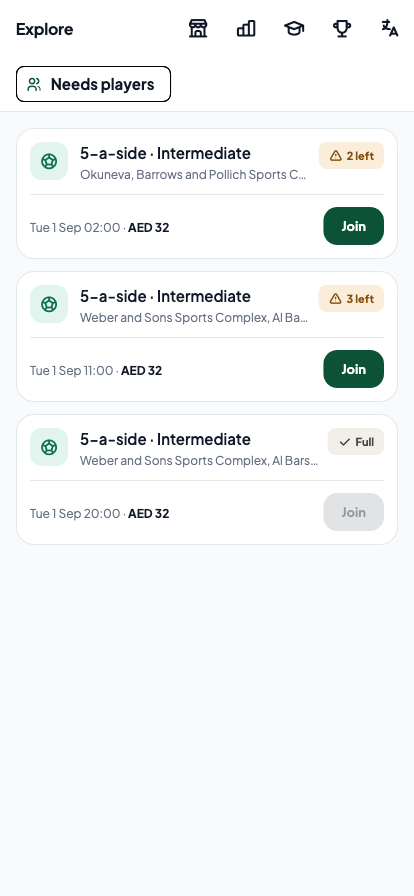
Two left, three left, full. A game you cannot join says so instead of letting you try.
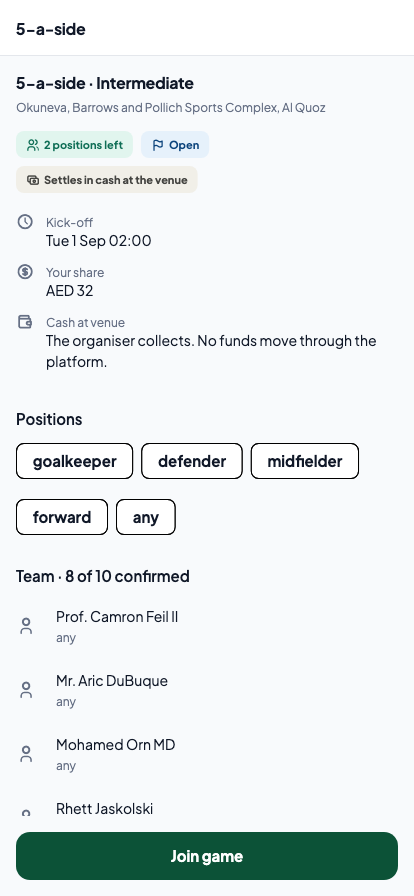
“Cash at the venue · the organiser collects. No funds move through the platform.” Said before you join, not after.
Cancelling costs something.
It never becomes our money.
Pulling out at five o'clock on the day is paid for by nine other people, and you should be told that before you tap it — so you are. What you forfeit stays in the game pot and lowers what everybody else owes for the same pitch. It is not a fine, and it is not revenue.
Nothing
Full refund. No mark against you. There is still time to fill your place.
Half your share
Stays in the pot. Everybody else pays a little less for the same pitch.
Your whole share
Same again — into the pot, not to us.
If your place refills, you get it all back
The penalty is refunded in full and the mark on your record is reversed. You cancelled and somebody else played — nothing was lost, so nothing is charged.
A cash game charges nothing at all
No money is held, so there is nothing to forfeit. Cancelling a cash game costs you reliability and nothing else.
Not turning up is different from cancelling
A no-show is the one case that carries a flat fee on top, and a week without invitations. Telling people is free; not telling them is what costs.
The clock is the venue's, not your phone's
Every window is measured in Dubai time on our server. A device with a wound-back clock cannot buy itself a free cancellation.
A team is a name, a captain and a roster
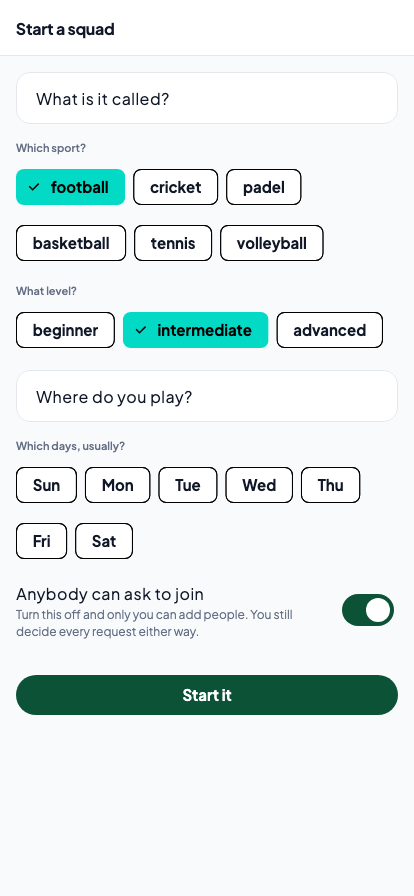
Four questions and a switch.
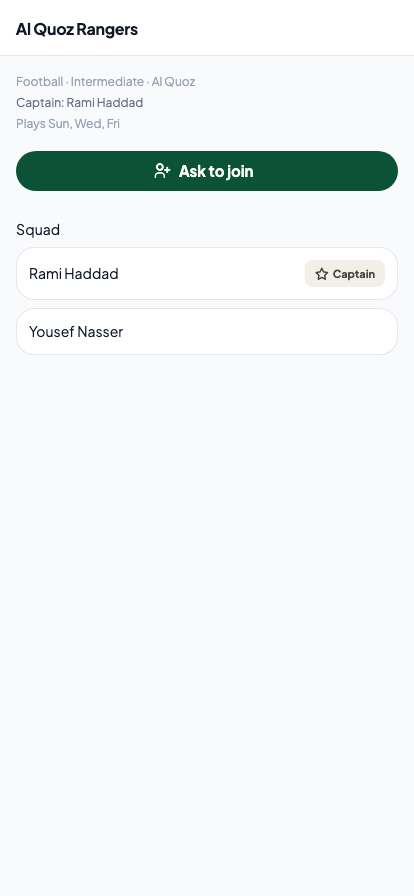
The captain is marked. Everybody can see who decides.
Name it, pick the sport and the level, say where and which days you usually play. That is the whole setup — and the days matter, because they are what makes the team findable by people looking for exactly that game.
Then choose whether anybody can ask to join. Leave it on and strangers can request a place; turn it off and only you can add people. Either way you decide every request. Asking is never the same as joining.
Borrowing a player for one match
A squad short on the day can borrow somebody from another team. Three people have to agree, in this order, and it is one match only:
The player agrees
Nobody is loaned out without being asked. They see who wants them and for which game.
Their own captain approves
The team they already play for is not losing them by surprise.
They are added to the roster
Labelled as a guest appearance, everywhere it shows.
It is called a guest appearance and never a transfer — because that is what it is, and calling it the other thing is how a friendly favour turns into an argument.
Say when you are free, and the games come to you
An organiser two players short at six on a Tuesday does not want to message forty people. They want the ones who play that sport, at that level, near that pitch, who are free at that hour, and who have a record of turning up.
Fill in your usual evenings and you are that person. There is also I am free right now — for the afternoon you find yourself with nothing on, which stops on its own after a few hours so you are never offered a game you had forgotten about.
Leave it empty and you are still invitable — you are just never at the top of anybody's list. That sentence is on the screen itself, because a setting that quietly costs you games should say so.
Turning up is worth something
Reliability is how often you actually came, built from games you were on the roster for. It is not a rating of how good you are, you cannot edit it, and organisers see it before they invite anybody. It is the single thing that decides who gets asked first.
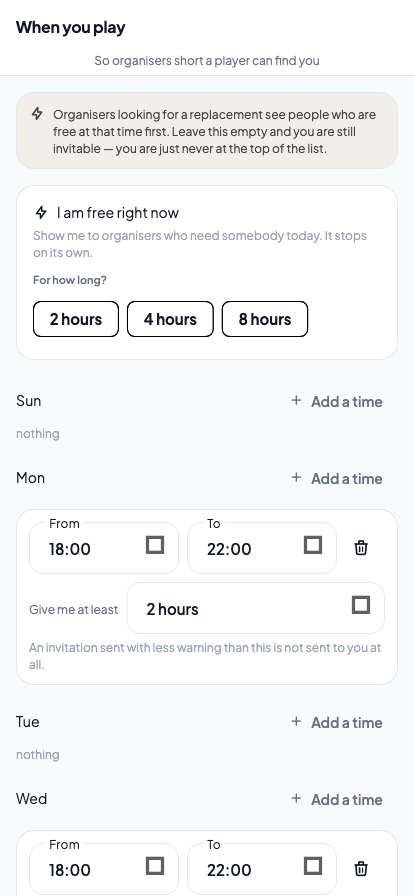
“Give me at least 2 hours” — an invitation with less warning than that is never sent to you at all.
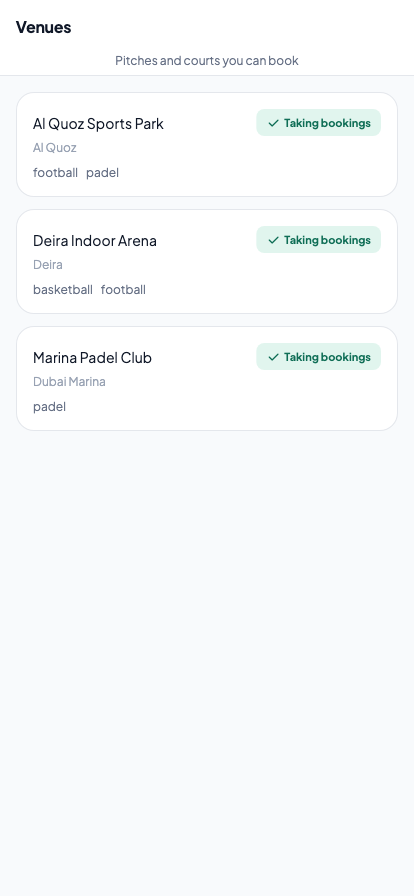
Pitches and courts you can actually book
Every venue on the list has been checked by us before it appears — a place that has not been verified is not shown to anybody. You can see which sports each one plays, which pitches and courts it has, and what is still unsold.
Book the whole slot yourself and invite people, or join something already on there. The venue sets its own cancellation terms, and those terms are frozen onto your booking the moment you make it.
Free to join, English and العربية
The app is in testing across football, padel, basketball, tennis and cricket. Tell us where you play and we will let you know when it opens near you.
Get in touch